Why Whisper AI Fails at Islamic Audio (And The Best Alternative for Scholars)
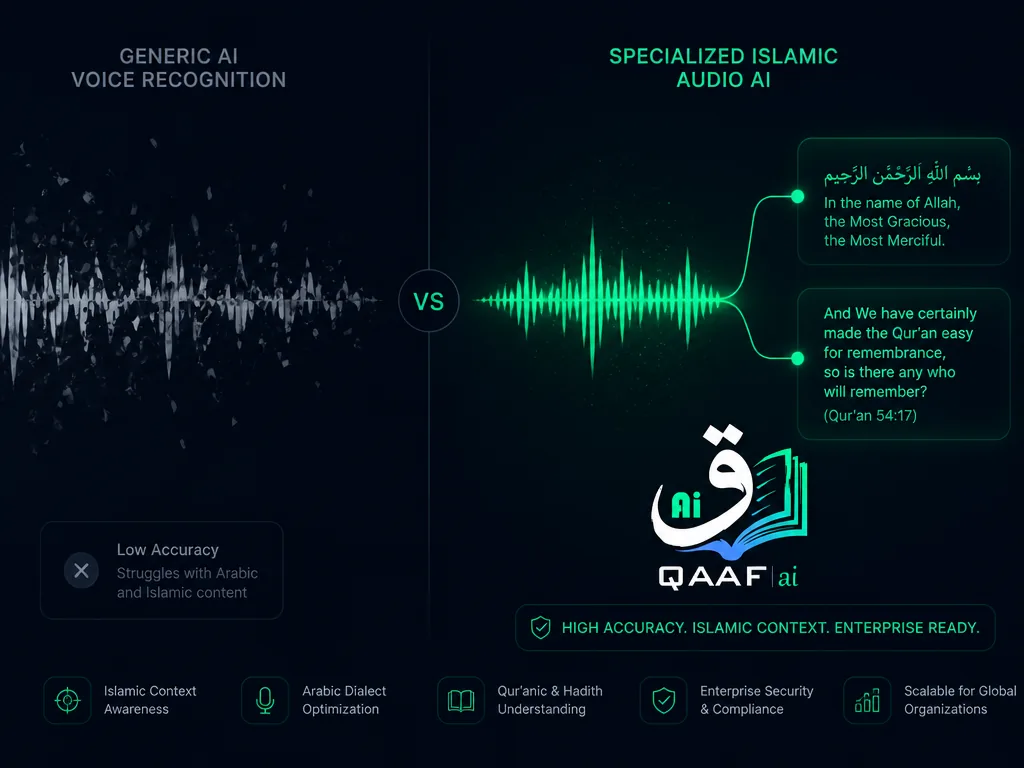
Qaaf AI’s specialized audio engine outperforming general AI in transcribing complex Islamic lectures. We also provide FREE IT & AI Consultancy for Islamic Institutes globally.
Quick Answer: Is Whisper AI good for transcribing Islamic lectures? While OpenAI's Whisper AI is excellent for single-language, conversational audio, it critically fails at Islamic scholarly lectures. Because it lacks a theological context engine, it hallucinates when a speaker mixes regional languages (like Urdu or Pashto) with classical Arabic Quranic references. To prevent the corruption of sacred text and Fiqh terminology, Islamic media teams use domain-specific platforms like Qaaf AI, which isolates languages, protects Quranic Ayahs, and accurately transcribes audio to text for global distribution.
The Era of Automated Speech Recognition (ASR)
The release of advanced speech-to-text models has transformed the global media landscape. Content creators across the world are utilizing tools like OpenAI’s Whisper AI, alongside various third-party "Whisper app" clones, to instantly transcribe audio to text.
For the Islamic education sector, this technology initially felt like a miracle. Darul Ulooms, Islamic NGOs, and YouTube content creators are sitting on tens of thousands of hours of incredibly valuable recorded Bayans (sermons) and Tafseer classes. The goal is to digitize these massive archives—turning spoken lectures from renowned scholars into written articles, subtitles, and translated English notes. However, as media teams quickly discovered, applying a generic Silicon Valley algorithm to complex Islamic theology results in an academic disaster.
The Architectural Flaw in Whisper AI
To understand why mainstream AI fails, you have to understand how models like Whisper AI are trained. They rely on vast datasets of conversational internet audio. They are optimized for podcasters, corporate meetings, and casual speech. Islamic scholarly discourse operates on a completely different linguistic framework.
When an esteemed scholar delivers a lecture, they do not speak in a vacuum. A typical 40-minute Bayan involves the scholar explaining a concept in high-level Urdu, Pashto, or English, and then seamlessly transitioning into classical Arabic to recite a Quranic Ayah, quote a historical Hadith, or cite a complex legal ruling (Fiqh).
The Mixed-Language Hallucination
When Whisper AI encounters this rapid, seamless transition between Urdu and classical Arabic, the algorithm panics. Because it is desperately trying to fit the audio into its primary recognized language model, it attempts to transcribe the sacred Arabic text using Urdu or English phonetics.
The system hallucinates. It guesses words. The resulting transcript completely destroys the scholarly reference, corrupts the religious ruling, and renders the document a theological liability.
The Industry Standard: Qaaf AI's Theological Engine
The Islamic academic sector cannot rely on generic, one-size-fits-all algorithms. It requires a domain-specific engine. This critical void in the market led to the engineering of the Qaaf AI Audio Transcriber.
Unlike generic apps, Qaaf AI was architected strictly for Islamic scholars, publishing houses, and media production teams. When you paste a YouTube link or upload an MP3 of a mixed-language Islamic lecture into Qaaf AI, the engine applies a dual-language theological lens to the waveform. First, it flawlessly isolates the regional spoken narrative (such as Urdu, Sindhi, or Pashto). Second, it actively listens for transitions into classical Arabic. When a Quranic verse or Hadith is recited, the AI ring-fences the sacred text, protecting it from algorithmic distortion.
Frequently Asked Questions (FAQs)
Q: Is there a Whisper app specifically designed for Islamic lectures?
A: Mainstream Whisper apps struggle with mixed-language Islamic terminology. Qaaf AI serves as the specialized alternative, engineered specifically to transcribe Islamic audio to text while flawlessly protecting Quranic and Hadith references from mistranslation.
Q: Can I use Qaaf AI to transcribe an Arabic lecture and translate it to English?
A: Yes. You can upload an Arabic audio file or paste a YouTube link, and the Qaaf AI engine will process the transcription and translation simultaneously, outputting highly accurate English text for your global audience.
Q: Do you offer custom software for larger Islamic Universities?
A: Absolutely. Beyond our web tools, Qaaf AI offers bespoke software development, custom Learning Management Systems (LMS), Islamic Mobile Apps, and complex AI integrations to help major institutes digitize their infrastructure.
🤝 Claim Your FREE Enterprise IT & AI Consultancy
Qaaf AI operates far beyond basic software tools. We are a premium Global Technology Consultant for the Muslim Ummah, proudly acknowledged for our technological impact and integrity by global industry leaders, including a leading Islamic publisher.
We provide 100% FREE expert IT and AI consultation for Islamic organizations, Madrasas, and NGOs worldwide. Whether your institute requires bespoke enterprise software developed from scratch, custom web design, automated API integrations to digitize your massive archives, or a fully custom-coded mobile app, our lead engineers are at your service. Budget should never prevent the preservation of classical knowledge.
Architect your digital future. Book your FREE strategy session with our engineering team today:
- 📱 WhatsApp: +92 3302527151
- ✉️ Email: contact.qaafai@gmail.com
About the Author: Eng. Ali
Ali is the Lead AI Architect and Founder of Qaaf AI. With deep expertise in Natural Language Processing (NLP) and Islamic software infrastructure, he provides global IT consulting for Darul Ulooms and NGOs. Qaaf AI's tools are used by established Islamic publishers and research institutes.
Ready to save time?
Upload a file and see the output before you commit to anything.
Try Qaaf AI free